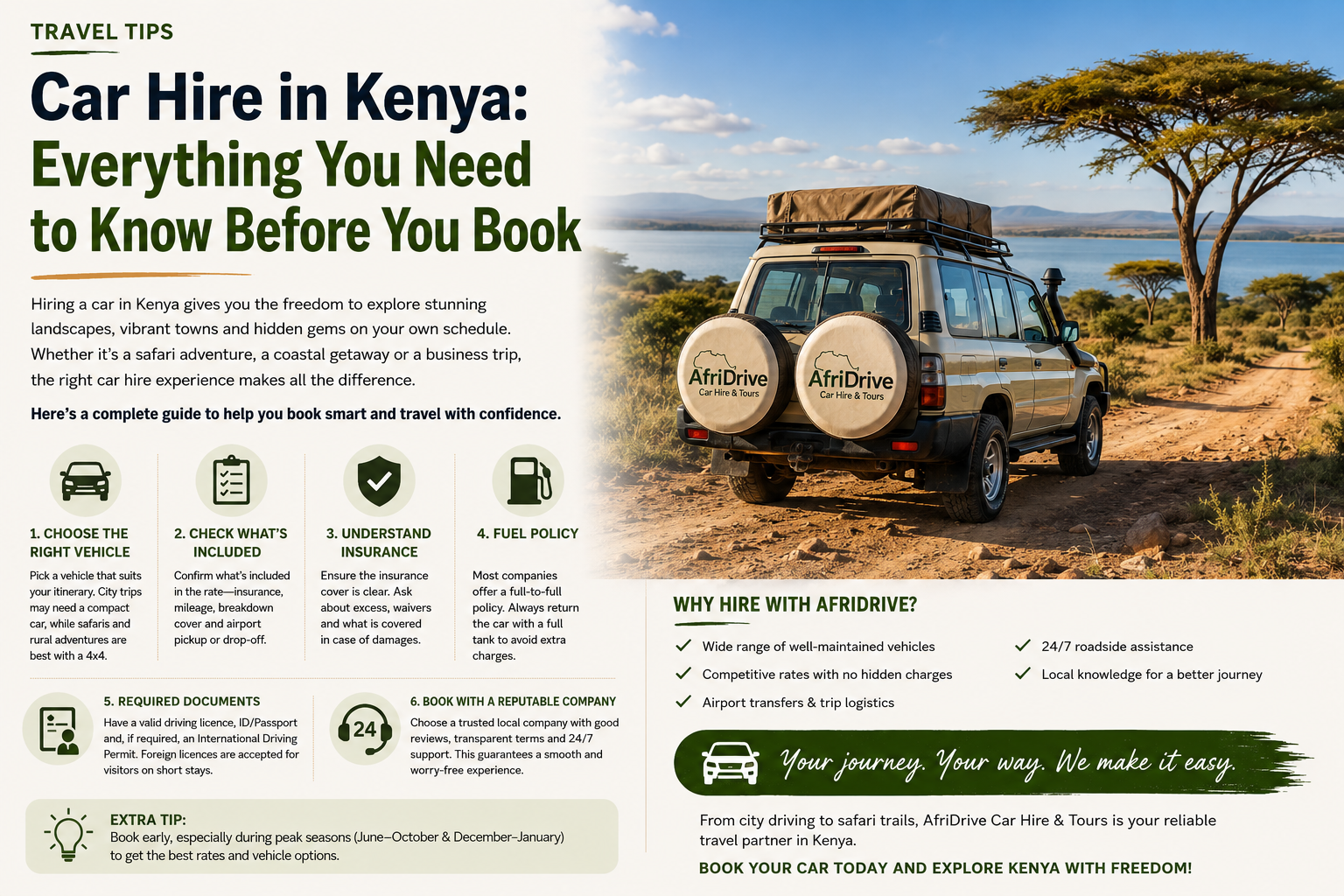
Hiring a car in Kenya can completely change the way you experience the country.
Instead of depending on fixed tour schedules or waiting for taxis, you can travel according to your own plans, stop whenever you discover something interesting, and explore destinations at your own pace.
Whether you're visiting Kenya for a safari, taking a family holiday, attending business meetings, or planning a coastal getaway, choosing the right rental vehicle and understanding the terms of your booking can save you money, time and unnecessary stress.
Here are the most important things to consider before hiring a car in Kenya.
1. Choose a Vehicle That Matches Your Journey
The cheapest vehicle isn't always the best vehicle.
Think about where you intend to drive before making your booking.
If you're staying mainly within Nairobi, a small, fuel-efficient car may be perfectly suitable. If you're travelling with family and luggage, an SUV may provide greater comfort.
For safari destinations and rougher roads, a 4x4 may be the better choice.
Consider:
- Number of passengers
- Amount of luggage
- Distance you plan to travel
- Road conditions
- Fuel consumption
- Ground clearance
- Automatic or manual transmission
- Air conditioning
- Boot space
A vehicle that is comfortable for a city trip may not necessarily be suitable for a safari adventure.
2. Find Out Exactly What's Included
Before paying for your rental, make sure you understand what you're getting.
Ask the car-hire company whether the quoted price includes:
- Insurance
- Unlimited or limited mileage
- Breakdown assistance
- Airport pickup or drop-off
- Additional drivers
- Delivery and collection
- Taxes and applicable fees
- Child seats, if required
- Cross-border travel permissions, where applicable
A low advertised daily rate can become considerably more expensive if several additional charges are added later.
Always ask for the complete rental terms before confirming your booking.
3. Understand the Insurance
Insurance is one of the most important parts of a car-hire agreement.
Don't simply assume that every type of damage is automatically covered.
Ask what the policy covers and whether there is an excess or deductible that you would be responsible for in the event of an accident.
You should also understand what happens in situations involving:
- Accidents
- Theft
- Windscreen damage
- Tyre damage
- Undercarriage damage
- Unauthorised drivers
- Negligent driving
If you're unsure about any part of the insurance arrangement, ask the rental company to explain it before collecting the vehicle.
4. Check the Fuel Policy
Different rental companies may use different fuel policies.
A common arrangement is "full-to-full", where you receive the vehicle with a full tank and return it with a full tank.
Whatever the arrangement is, make sure you understand it before driving away.
For long-distance journeys, fuel planning becomes particularly important.
If you're travelling into remote areas, don't assume that you'll find a petrol station whenever you need one.
5. Have the Required Documents Ready
Before collecting your vehicle, confirm which documents are required for your rental.
These may include:
- Valid driving licence
- Passport or national identification
- International Driving Permit where applicable
- Rental booking confirmation
- Payment card or required deposit
- Additional identification requested by the rental provider
International visitors should confirm their driving-document requirements before arriving in Kenya.
Having everything ready can make the vehicle collection process much faster.
6. Inspect the Vehicle Before Driving Away
Take a few minutes to inspect the vehicle carefully.
Check the exterior for scratches, dents and other existing damage.
You should also check:
- Tyres
- Spare wheel
- Lights
- Indicators
- Mirrors
- Windscreen
- Seat belts
- Air conditioning
- Fuel level
- Warning lights
Take photographs or a short video of the vehicle before departure.
If you notice existing damage, make sure it is recorded in the rental documentation.
This simple step can help avoid disagreements when the vehicle is returned.
7. Consider Your Driving Experience
Driving in Kenya can be very different from driving in your home country.
Nairobi can experience heavy traffic, while rural roads may present different challenges.
Long-distance driving also requires concentration and proper planning.
If you are unfamiliar with Kenyan roads or simply don't want to drive yourself, consider hiring a vehicle with a professional driver.
A chauffeur can allow you to concentrate on enjoying your trip while someone familiar with the roads handles the driving.
8. Think About Your Destination
Your destination should influence the type of vehicle you hire.
For example, a city-focused trip around Nairobi may require a completely different vehicle from an itinerary that includes Maasai Mara, Amboseli, Samburu or other safari destinations.
Before booking, tell your rental provider where you intend to travel.
A reputable company can help you choose a vehicle that is appropriate for your route.
9. Don't Forget About Luggage
Luggage is often overlooked when selecting a rental vehicle.
Five people may technically fit into a five-seater car, but that doesn't necessarily mean there will be enough space for five large suitcases.
If you're travelling as a family or group, consider the boot capacity carefully.
An SUV or larger vehicle can provide considerably more comfort for longer journeys.
10. Plan Your Route in Advance
Before collecting your car, have a general idea of where you're going.
You don't necessarily need every minute planned, but you should know:
- Your main destinations
- Approximate driving distances
- Accommodation locations
- Fuel stops
- Major roads
- Alternative routes
- Areas where mobile coverage may be limited
Download important maps for offline use where possible.
This is particularly useful when travelling outside major towns.
11. Book Early During Busy Travel Periods
Vehicle availability can become more limited during popular travel periods.
If you're travelling during school holidays, festive periods or peak safari seasons, booking your vehicle early gives you more choice.
Early booking can also make it easier to secure the vehicle category you actually want instead of choosing from whatever remains available.
12. Ask About Roadside Assistance
Before starting your journey, make sure you know who to contact if something goes wrong.
Ask your rental company about its roadside assistance arrangements.
Save the company's phone number in your phone before leaving.
A reliable rental provider should be able to tell you what to do if you experience:
- A flat tyre
- Mechanical problems
- An accident
- A breakdown
- Battery problems
- Other emergencies
Having this information before you need it can save valuable time.
13. Compare More Than Just Prices
When comparing car-hire companies in Kenya, don't automatically choose the company offering the lowest daily rate.
Consider the complete package.
Look at:
Vehicle quality
Is the fleet properly maintained?
Customer support
Can you reach someone when you need help?
Rental terms
Are the conditions clearly explained?
Insurance
Do you understand what is covered?
Mileage
Are there mileage restrictions?
Vehicle availability
Will the exact category you booked actually be available?
Additional services
Does the company provide airport transfers, trip planning or chauffeur services if you need them?
The cheapest rental isn't necessarily the best value.
14. Why Local Knowledge Matters
A local car-hire company can offer more than just the keys to a vehicle.
Local knowledge can be particularly useful when planning longer journeys.
A knowledgeable provider can advise you about suitable vehicles, routes, driving conditions and travel logistics.
AfriDrive, for example, provides car hire alongside airport transfers, event logistics and trip logistics, allowing travellers to arrange different parts of their transportation through one provider.
Car Hire Options for Different Types of Travellers
For City Travellers
If your trip is primarily around Nairobi, a compact or executive vehicle may provide the best combination of comfort, convenience and fuel efficiency.
For Families
Families may prefer an SUV or larger vehicle with additional passenger and luggage space.
For Safari Travellers
If your itinerary involves safari destinations or challenging terrain, discuss your route with the rental company and select a suitable 4x4.
For Business Travellers
An executive sedan can provide a comfortable and professional option for meetings, airport transfers and corporate travel.
For Long Road Trips
Comfort, fuel economy, luggage capacity and reliability become especially important when you're spending several hours on the road.
Why Choose AfriDrive?
AfriDrive provides a range of vehicles designed for different travel requirements, from economy cars and executive vehicles to SUVs. Its current fleet includes options such as the Nissan Note e-POWER, Mazda Axela, Nissan Sylphy, Subaru Levorg and Mazda CX-8.
The company also provides airport transfers, event logistics and trip-planning support, making it possible to combine vehicle hire with additional travel services.
For travellers who want flexibility, the right vehicle can make exploring Kenya considerably easier.
Final Thoughts
Hiring a car in Kenya gives you something that a fixed itinerary cannot always provide: freedom.
You can decide when to leave, where to stop and how long to stay.
But that freedom works best when your rental is properly planned.
Choose a vehicle that matches your destination, understand the rental agreement, confirm the insurance, inspect the car before departure, plan your fuel and route, and make sure you have reliable support available during your journey.
Whether you're heading across Nairobi, taking a family road trip, exploring Kenya's national parks or travelling toward the coast, the right rental vehicle can make the journey part of the adventure.
Ready to Hire a Car in Kenya?
Explore Kenya with a vehicle suited to your journey and travel with confidence.
Contact AfriDrive Car Hire & Tours to find the right vehicle for your next trip.
Comments
0Leave a Comment
We'd love to hear your thoughts
No comments yet
Be the first to share your thoughts and join the conversation!